



Fast Dispatch from Newry: No customs charges or import fees to ROI & UK
- Brand: ICF Nextmune
- Sku: VRSICF001
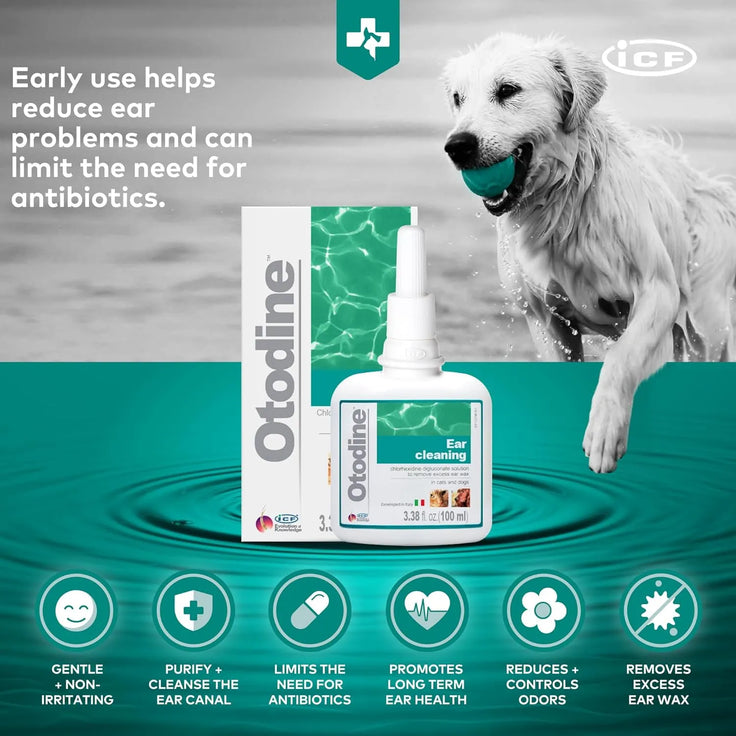
ICF Otodine Ear Cleaning Solution for Dogs & Cats – 100ml
ICF Otodine Ear Cleaning Solution for Dogs & Cats – 100ml
ICF Otodine Ear Cleaning Solution is a specialist veterinary ear cleanser for dogs and cats, formulated with 0.15% chlorhexidine digluconate and Tris-EDTA to help remove excess earwax, manage bacterial and yeast overgrowth, and maintain healthy external ear canals.
Developed for pets requiring more than basic ear hygiene, Otodine combines the antimicrobial properties of chlorhexidine with the enhancing action of Tris-EDTA. This combination is particularly useful for animals prone to recurrent ear problems and may be recommended by veterinary surgeons before applying prescribed ear medication.
Unlike ordinary cosmetic ear cleaners, Otodine has a specific role in veterinary ear care protocols. It can be used for routine maintenance, alongside prescribed treatments, or in selected cases of mild microbial overgrowth confirmed by veterinary examination.
The 100ml bottle features a narrow applicator nozzle for convenient administration.
Key Benefits of ICF Otodine
- 0.15% chlorhexidine digluconate: An antiseptic ingredient with activity against various bacteria and yeasts.
- Tris-EDTA formulation: Helps enhance the activity of chlorhexidine and certain antimicrobial medications.
- For dogs and cats: Developed for veterinary ear hygiene.
- Helps remove earwax: Assists with cleaning accumulated cerumen and debris.
- Supports management of microbial overgrowth: Can be used in selected cases under veterinary guidance.
- Useful before medicated ear drops: Helps prepare the ear canal for prescribed topical treatment.
- Suitable for ongoing maintenance: May be used long-term in pets prone to recurrent ear problems.
- Near-neutral to mildly alkaline pH: Formulated at approximately pH 7–8.
- Non-prescription product: Available without a veterinary prescription.
- 100ml bottle: Convenient for home ear care.
How Does Otodine Work?
Otodine combines two ingredients with complementary functions.
Chlorhexidine Digluconate – 0.15%
Chlorhexidine is a widely used antiseptic with antimicrobial activity against many Gram-positive bacteria, some Gram-negative bacteria and certain yeasts.
At a concentration of 0.15%, it is incorporated into Otodine to help manage microbial populations within the external ear canal.
Its activity is useful in veterinary ear hygiene, particularly when bacterial or yeast overgrowth contributes to recurring ear problems.
Chlorhexidine does not treat every cause of ear disease. Ear mites, foreign bodies, allergies and some infections require additional veterinary treatment.
Tris-EDTA
Tris-EDTA combines tromethamine (Tris) with ethylenediaminetetraacetic acid (EDTA).
EDTA is a chelating agent that binds certain metal ions and can destabilise the outer membranes of some bacteria, particularly Gram-negative organisms.
This action may increase bacterial susceptibility to chlorhexidine and certain antibiotics.
Tris-EDTA formulations are frequently used in veterinary dermatology and ear care, including protocols involving difficult-to-manage bacterial infections.
The exact concentration of Tris-EDTA in Otodine is not specified in the publicly available product information.
Why Is the pH Important?
Otodine is formulated at approximately pH 7–8.
According to the manufacturer's UK guidance, its formulation allows it to be used before compatible medicated ear drops without a mandatory waiting period.
Always follow the instructions for the prescribed medication, as individual products and treatment protocols can differ.
When Can Otodine Be Used?
Otodine may be recommended for:
- Routine ear cleaning in dogs and cats
- Removal of excess earwax and debris
- Maintenance of ears prone to recurrent problems
- Cleaning before prescribed ear medication
- Veterinary-managed bacterial otitis externa
- Selected cases of mild yeast overgrowth
- Mild microbial overgrowth confirmed by ear cytology
- Long-term hygiene programmes for pets with recurrent ear disease
Dogs with environmental allergies may be particularly prone to recurrent ear inflammation. Regular ear care can form part of their management plan, although the underlying allergy must also be addressed.
Recommended Otodine Treatment and Maintenance Schedules
The appropriate frequency depends on whether Otodine is being used for routine maintenance, alongside prescribed medication or for veterinary-confirmed microbial overgrowth.
| Reason for Use | Published Guidance |
|---|---|
| Routine maintenance | 1–2 times weekly |
| Before prescribed ear drops | Daily, according to veterinary instructions |
| Mild bacterial or yeast overgrowth confirmed by cytology | Daily for 10–14 days, followed by maintenance where appropriate |
| Alternative intensive cleaning protocol | 1–2 times daily for at least 10 days, when directed |
| Recurrent ear problems | Long-term maintenance, typically 1–2 times weekly, adjusted by the vet |
These schedules are drawn from published manufacturer and veterinary distributor instructions. They are not a substitute for an individual veterinary treatment plan.
Routine Ear Maintenance
For pets prone to recurrent ear problems, the manufacturer recommends using Otodine approximately once or twice weekly as ongoing maintenance.
The frequency may need to be reduced if the ears become irritated or if regular cleaning is unnecessary.
Before Prescription Ear Drops
Otodine may be used daily as a preparatory cleanser before compatible medicated ear drops.
Cleaning can help remove debris that might otherwise interfere with contact between medication and the ear canal.
Follow your vet's instructions regarding timing, cleaning frequency and whether the prescribed drops should be applied immediately afterwards.
Mild Bacterial or Yeast Overgrowth
Where veterinary cytology identifies mild bacterial or yeast overgrowth, the manufacturer's UK brochure describes using Otodine daily for 10–14 days, followed by maintenance cleaning once or twice weekly when appropriate.
More severe infections, significant inflammation or persistent symptoms may require prescription treatment and further investigation.
Alternative Intensive Cleaning Schedule
Some UK veterinary distributors provide an alternative protocol of 3–6ml per application, once or twice daily for at least 10 days.
Other published instructions describe twice-daily use for 14 days.
These more intensive schedules should be followed only when appropriate for the individual pet and recommended by a veterinary professional.
How to Use Otodine Ear Cleaning Solution
- Examine the ear: Do not proceed without veterinary advice if the ear is severely painful, swollen, bleeding or producing significant discharge.
- Lift the ear flap: Gently expose the opening of the external ear canal.
- Apply the solution: Introduce the nozzle near the opening without inserting it deeply or allowing the tip to touch the skin. Apply the amount directed by your vet or the current packaging.
- Massage the base of the ear: Massage gently for approximately 30–60 seconds to distribute the cleanser and loosen wax.
- Allow excess solution to escape: Let your pet shake their head if comfortable.
- Remove loosened debris: Use soft cotton wool or gauze to wipe the visible ear and accessible folds.
- Repeat if directed: Continue according to the recommended schedule.
- Apply prescribed medication if required: Follow your veterinary surgeon's instructions for combining Otodine with medicated drops.
Do not push cotton buds or other objects deep into the ear canal.
Do not routinely flush painful or infected ears without a veterinary examination.
Composition and Active Ingredients
| Ingredient | Concentration or Function |
|---|---|
| Chlorhexidine Digluconate | 0.15% |
| Tris-EDTA | Chelating and antimicrobial-enhancing system; exact concentration not published |
| pH | Approximately 7–8 |
| Other formulation ingredients | Formulation-dependent solvents and purified water |
Published ingredient declarations differ between markets and product versions. UK listings describe a formulation containing propylene glycol and a Tris-EDTA buffering system, while the US-labelled product lists a different set of excipients.
Always consult the packaging supplied with the product for the exact local formulation.
Otodine and Bacterial Ear Infections
Bacterial otitis externa is inflammation of the external ear canal associated with bacterial overgrowth or infection.
Common symptoms can include:
- Unpleasant ear odour
- Increased discharge
- Redness and inflammation
- Head shaking
- Scratching at the ears
- Sensitivity when the ears are touched
- Excessive wax or debris
Otodine's chlorhexidine and Tris-EDTA combination can be useful in veterinary management of bacterial ear problems.
However, ear infections should ideally be assessed using otoscopy and ear cytology to identify the likely cause and determine whether prescription medication is necessary.
Recurrent infections may be associated with underlying allergies, anatomical factors, moisture, foreign bodies or other conditions.
Can Otodine Help with Yeast Ear Infections?
Chlorhexidine has activity against certain yeasts, including organisms relevant to canine ear disease.
The manufacturer includes Otodine among products suitable for helping manage mild yeast overgrowth.
However, confirmed yeast otitis may require specific antifungal medication, particularly when inflammation or infection is significant.
Otodine should not be presented as a guaranteed standalone cure for yeast infections.
Otodine for Dogs with Allergies
Dogs with environmental allergies, including atopic dermatitis, commonly experience recurrent ear inflammation.
Allergic inflammation can change the ear canal environment and predispose the dog to secondary bacterial or yeast overgrowth.
Otodine may be useful within a veterinary-directed ear maintenance programme, but it does not treat the underlying allergy.
Pets with known chlorhexidine sensitivity should not use Otodine.
Product Specifications
| Feature | Details |
|---|---|
| Brand | ICF |
| Product | Otodine Ear Cleaning Solution |
| Pack Size | 100ml |
| Suitable For | Dogs and cats |
| Chlorhexidine Concentration | 0.15% |
| Additional Active System | Tris-EDTA |
| Formulation pH | Approximately 7–8 |
| Product Type | Veterinary ear cleanser |
| Application | External ear canal |
| Routine Maintenance | Typically 1–2 times weekly |
| Intensive Use | According to veterinary instructions |
| Prescription Required | No |
Frequently Asked Questions
What is ICF Otodine used for?
Otodine is a veterinary ear cleanser for dogs and cats. It helps remove excess earwax and debris and may support management of bacterial or yeast overgrowth as part of an appropriate ear care programme.
What percentage of chlorhexidine does Otodine contain?
Otodine contains 0.15% chlorhexidine digluconate.
How much Tris-EDTA does Otodine contain?
Tris-EDTA is included in the formulation, but its exact concentration is not specified in the publicly available manufacturer information.
How often should Otodine be used?
For ongoing maintenance, the manufacturer recommends once or twice weekly. Daily use may be recommended before prescribed ear drops or for selected cases of mild microbial overgrowth. More intensive protocols require veterinary guidance.
How long should I use Otodine for an ear infection?
The manufacturer's UK brochure describes daily use for 10–14 days in selected cases of mild overgrowth confirmed by cytology. Other published protocols specify once or twice daily for at least 10 days. The correct duration depends on the diagnosis and veterinary treatment plan.
How much Otodine should I put in my dog's ear?
Some UK instructions specify 3–6ml, while the manufacturer describes filling the external ear canal sufficiently for cleaning. The appropriate amount depends on the animal's ear size and condition. Follow your vet's instructions and the supplied product label.
Should I leave Otodine in the ear?
After application, massage the ear base and remove excess solution and loosened debris. Some published instructions include a 10-minute contact period, but this is not specified in every product protocol. Follow the instructions appropriate to your product and veterinary treatment.
Can Otodine be used before antibiotic ear drops?
Yes, Otodine is commonly recommended as a preparatory ear cleanser before compatible prescription ear medication. The manufacturer notes that its pH 7–8 formulation does not require a routine waiting period, although individual medication instructions take priority.
Does Otodine work against Pseudomonas?
Tris-EDTA can increase the susceptibility of certain Gram-negative bacteria, including Pseudomonas species, to some antimicrobial agents. However, a suspected Pseudomonas ear infection requires veterinary diagnosis and appropriate treatment. Otodine alone should not be assumed sufficient.
Can Otodine be used for yeast infections?
The formulation has activity relevant to some yeasts and may be recommended for mild overgrowth. More significant yeast infections may require prescription antifungal medication.
Can I use Otodine every day?
Daily use is included in some veterinary treatment protocols. For routine long-term maintenance, the manufacturer generally recommends once or twice weekly.
Can I use Otodine on a dog with allergies?
Otodine may be used in some dogs with allergic ear disease, but it should be avoided in animals with known chlorhexidine sensitivity. A vet should assess inflamed or painful ears before treatment.
Is Otodine safe if the eardrum is ruptured?
Do not use Otodine when a ruptured eardrum is known or suspected without veterinary direction. The manufacturer's UK brochure specifically warns against use in cats with a ruptured eardrum.
Does Otodine kill ear mites?
Otodine is not a dedicated ear mite treatment. Pets with ear mites generally require an appropriate antiparasitic medication.
Can Otodine be used in puppies and kittens?
Seek veterinary advice before use in puppies and kittens. The suitability of an ear cleanser depends on the animal's age, health and ear condition.
Does Otodine need to be rinsed out?
No additional water rinse is generally required. Excess cleanser and loosened debris should be wiped away as instructed.
Can I use Otodine for preventative ear cleaning?
Yes, where regular cleaning is appropriate. The manufacturer recommends once or twice weekly for ongoing maintenance in pets prone to recurrent ear problems. Healthy ears do not necessarily need routine cleaning.
Important Safety Information
- For veterinary ear use only.
- Do not use in animals with known chlorhexidine sensitivity.
- Do not use with a known or suspected ruptured eardrum unless specifically directed by a vet.
- Avoid contact with eyes.
- Do not insert the applicator nozzle deeply into the ear canal.
- Do not use cotton buds deep inside the ear.
- Stop use and seek veterinary advice if irritation or discomfort develops.
- Consult a vet before use in puppies, kittens, pregnant or lactating animals, and pets with existing medical conditions.
- Seek veterinary attention for persistent odour, discharge, pain, swelling, head tilt or balance problems.
- Store according to the product packaging and keep out of reach of children.
Shipping & Delivery
Shop Otodine and other veterinary ear care products at Pet Connection.
For delivery options, shipping charges and estimated delivery times, visit:
https://www.petconnection.ie/pages/shipping-option
Will I Have to Pay Customs Fees if Ordering to the Republic of Ireland?
No. Because Pet Connection is based in Northern Ireland, all shipments to the Republic of Ireland and the wider EU are fully exempt from border customs duties, import tariffs, and clearance fees.
Why Shop With Pet Connection?
At Pet Connection, we're committed to offering environmentally responsible pet products without compromising on quality or performance.
Explore our range of ear cleaners, grooming supplies, veterinary skin care products and everyday essentials for dogs and cats.
Have a question?


ICF Otodine Ear Cleaning Solution for Dogs & Cats – 100ml

Secure Payment

International Delivery

Pet care advice

Need More Information?
- Choosing a selection results in a full page refresh.